
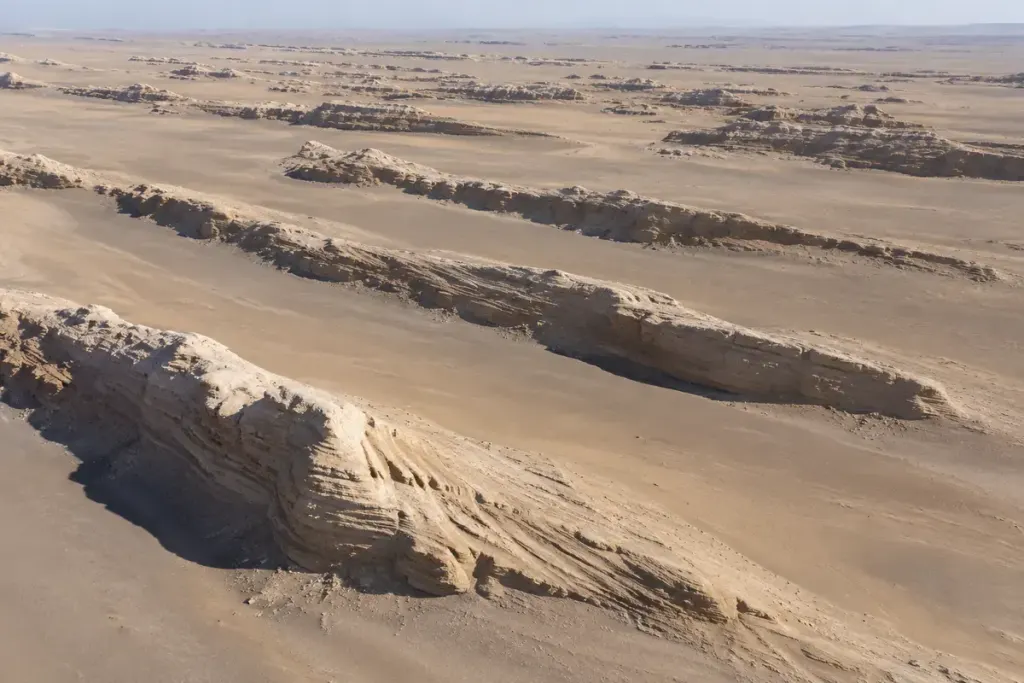
Some dry landscapes carry long, streamlined ridges separated by grooves. Their repeated direction can make the ground look as though it has been combed. Yardangs are one example of landforms produced by wind erosion.
The US National Park Service’s overview of aeolian landforms places yardangs alongside dunes, ventifacts and other wind-shaped features. The distinction between erosion and deposition is useful: a ridge left as surrounding material is removed is not the same process as a dune built from deposited sand.
Look for a pattern across the landscape
From a designated viewpoint or permitted route, notice whether several ridges share an orientation. Look at their ends, the spaces between them and the surrounding material. A single oddly shaped rock does not establish the same story as a repeated landform pattern.
Use the site’s geological interpretation or a reliable map to support identification. Similar-looking shapes can arise through different processes, and a travel photograph rarely shows all the evidence needed to distinguish them.
Record the viewing direction, location and scale. Include a distant landscape feature where possible, rather than asking someone to climb onto fragile material for a size comparison. Keep people and equipment on permitted ground.
Read the wind without treating it as a forecast
A landform records processes over time. Its orientation does not guarantee that the wind on the day of your visit will blow in that direction. Check current conditions separately when planning an exposed walk.
For a field notebook, make two sketches: the shape of one ridge and the arrangement of several. Then write which parts are direct observations and which come from the site’s explanation. This is a useful way to avoid turning a striking appearance into a confident but unsupported history.
Leave the surface as you found it. Scratching, collecting or walking across vulnerable formations can remove evidence and damage the place others came to see.
The reward is a different way of looking at a desert or other wind-worked terrain: not as empty ground, but as a landscape whose shapes preserve a long interaction between material and moving air.