
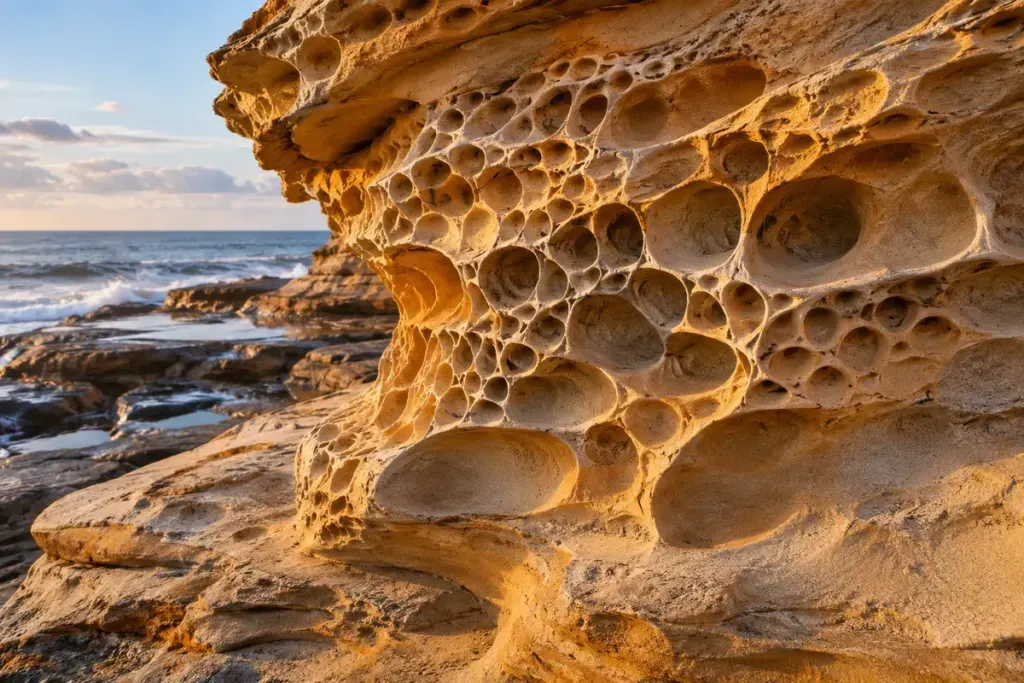
A rock face dotted with small hollows can look like a sponge or a miniature cave system. These patterns are often described as tafoni. They invite a closer look, but their delicate edges are a reason to observe carefully rather than climb or probe them.
The US National Park Service’s introduction describes rounded openings and clusters produced by uneven weathering. Its sandstone examples involve moisture and differences in the rock’s mineral cement. Elsewhere, the agency’s City of Rocks account discusses salt-related weathering in granite. A similar-looking pattern does not require one identical history everywhere.
A useful way to look
From the permitted path or viewing area, first look at the whole outcrop. Are the cavities concentrated under an overhang, along a layer or across an exposed face? Then look at the pattern within that area: similar-sized pockets, larger connected hollows, or thin partitions between them.
These observations help you describe what you saw without claiming to have established the mechanism. Identifying the rock and local geological setting needs more information than a close-up photograph alone.
For a simple field note, record:
- The location and date, using the site’s accepted place name where available.
- A wide photograph showing the feature in its surroundings.
- A closer photograph taken without touching or placing objects on the rock.
- The explanation given on a park sign or in an official geological guide.
Keep the observation separate from the explanation
“Small cavities concentrated below a projecting ledge” is an observation. “Salt caused every hole” is an interpretation that may need local evidence. Keeping the two apart makes the note more useful when you later compare it with a reliable guide.
Respect closures, fragile surfaces and any cultural features nearby. Do not scratch the rock to test its hardness or insert fingers into openings. If the feature is beyond a barrier, a distant photograph is enough.
A walk gains detail when you notice the smaller structures as well as the skyline. Tafoni offers a good opportunity to practise that attention while leaving the evidence exactly where the next visitor can see it.