
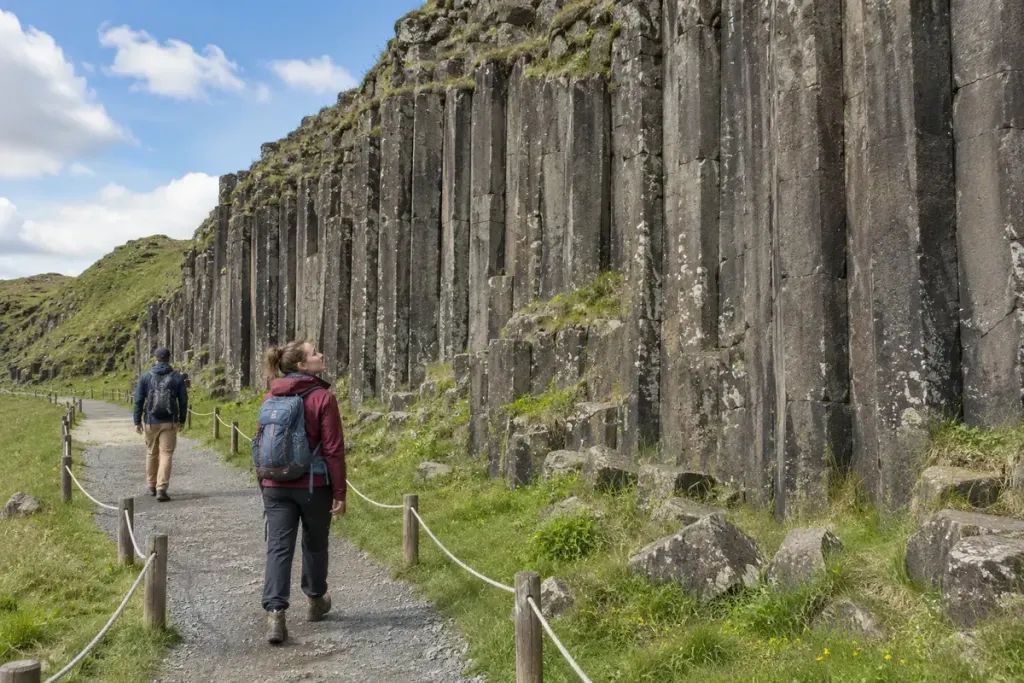
From a distance, a wall of basalt columns can look assembled: repeated upright shapes, flat sides, and joints that resemble courses of masonry. The pattern can instead be the result of cooling and contraction within volcanic rock.
The US Geological Survey’s account of Columbia River basalt flow interiors describes columnar and more irregular jointing within lava flows. Cracks divide the cooling rock into columns. Their apparent regularity does not mean that every column has the same number of sides or the same dimensions.
Choose two views of the outcrop
From a permitted viewing area, first look across the sides of the columns. Follow a long joint with your eyes and notice whether it remains straight. Then, if an exposed end is safely visible from the path, compare the polygonal outlines.
Those views answer different questions. A side view reveals length and alignment; an end view makes the cross-section easier to read. A photograph of only one face can leave you imagining a uniform shape that the other view would complicate.
Cooling surfaces influence the direction of joint development. USGS discusses such relationships in its volcanic geology material. A column leaning away from the vertical is therefore not, by itself, proof that somebody moved it or that it has recently shifted.
Record an observation before explaining it
Try writing “the columns become narrower towards the upper part of this view” before deciding why. Separate the visible pattern from a geological explanation you have not yet checked. A local interpretation panel or geological guide may identify the flow and explain features that a general account cannot resolve.
Stay on the established route and follow local access restrictions. An attractive column is not an invitation to climb a rock face or remove a sample. A wide photograph, a closer view from the path, and a location note provide a useful record while leaving the formation intact for the next visitor.