
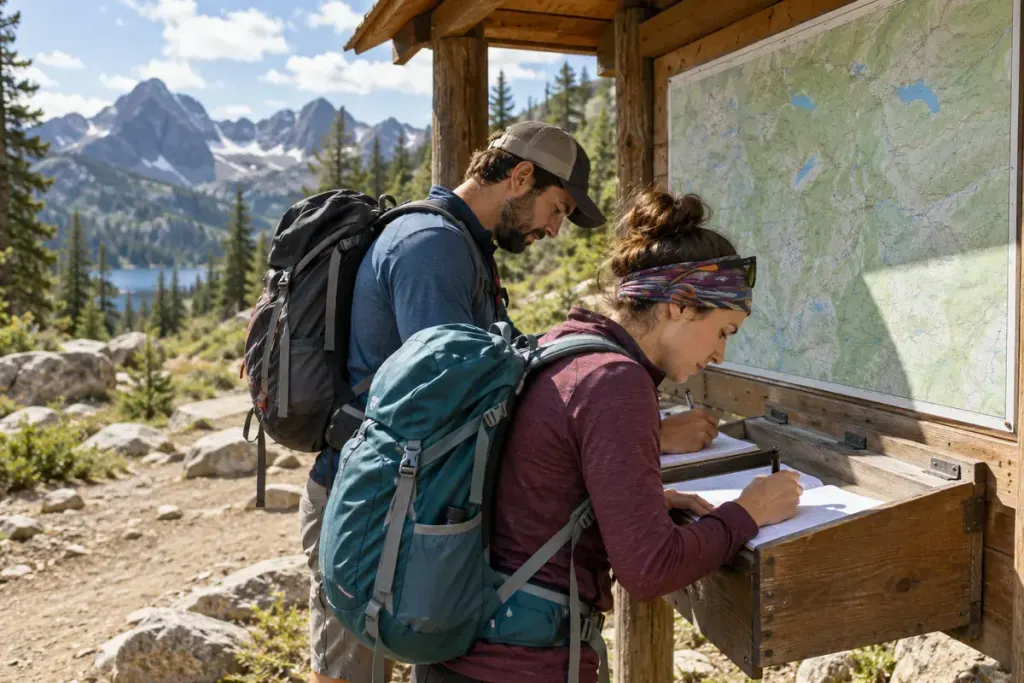
A trailhead register asks for a destination and an expected return. Filling it in can be useful, but the notebook does not know where you are once you leave the kiosk. Do not confuse a written record with live monitoring or an automatic alarm.
New York’s Department of Environmental Conservation describes trail registers as useful for visitor-use information and search efforts in its Shaker Mountain management plan. The National Park Service separately advises visitors to leave a trip plan and prepare for delayed rescue. Local arrangements differ, so check the instructions for the area you are visiting.
Write information that can be used
Follow the register’s fields and instructions legibly. Use the intended route or destination rather than an unexplained nickname. If the system asks you to sign out, remember that step when returning. Do not add sensitive information beyond what the official process requests.
A register entry can become a lead if someone later needs to establish your plans. It does not guarantee that staff will check it at your return time or begin a search if you are late. Unless the managing authority explicitly describes such a service, do not assume it exists.
Arrange a separate check-in
Give a trusted person the route, expected return and a clear action plan if they cannot reach you. Discuss how they should contact the appropriate local authority and what information they should provide. Update them when the trip ends or plans change.
Carry suitable navigation and communication equipment and know its limitations. A device, permit or register is not a promise that help will arrive quickly, especially in remote terrain.
Before walking away from the trailhead, ask what each part of the plan actually does: the register leaves information, the contact knows when to raise concern, and your equipment supports decisions on the route. Keeping those roles clear is more useful than assuming that one signature has placed the entire walk under supervision.