
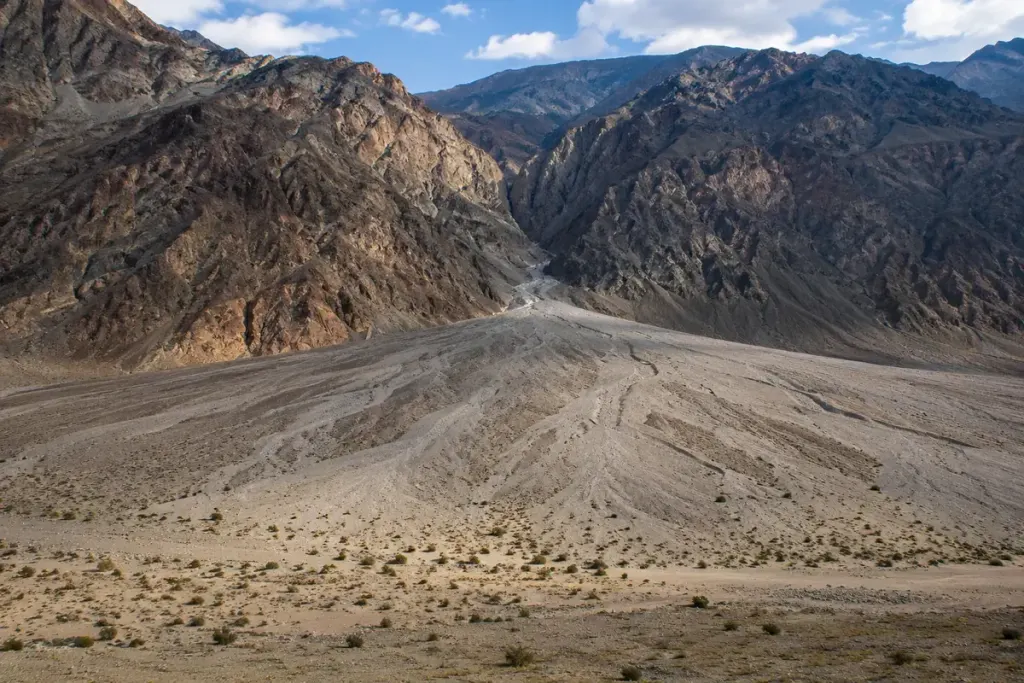
At the mouth of a mountain canyon, loose sediment may spread outward in a broad, gently sloping fan. From a high viewpoint, the shape can look almost deliberately arranged. It is a record of material transported from the valley and deposited beyond its confined channel.
The US Geological Survey’s alluvial-fan definition describes this fan-shaped accumulation where a stream emerges onto a plain or broad valley. The change in setting helps explain why sediment spreads rather than continuing through one narrow corridor.
Find the apex and follow the spreading shape
Look for the point near the canyon mouth where the fan begins. Then trace the surface outward. Channels, patches of differently sized material and changes in vegetation may help you read the form, although no single visual clue identifies every deposit reliably.
Use a map or a permitted viewpoint rather than leaving a marked route to chase a better angle. A distant photograph can reveal the overall pattern more clearly than standing in the middle of it.
A fan can contain more than one flow history
USGS guidance on alluvial fans distinguishes deposits associated with different kinds of flows, including water floods and debris flows. The broad shape alone does not tell the full story of every event that built it.
For a field note, separate what you can see from what you infer. “Several shallow channels spread from the canyon mouth” is an observation. The age, frequency and size of past flows require additional evidence.
Dry ground still needs a weather check
Alluvial-fan flooding can involve changing flow paths. Do not treat an apparently dry surface or an old channel as a guarantee that water will remain elsewhere during a storm. Follow local warnings, route advice and closures, including information about conditions upstream.
Before a walk, identify the relevant forecast area and the official source for access conditions. Avoid camping or waiting in a drainage route because it happens to be dry when you arrive.
The fan is both a landform and a record of movement. Reading its shape can enrich a walk, while remembering that the processes which built it may still be active keeps the observation grounded.