
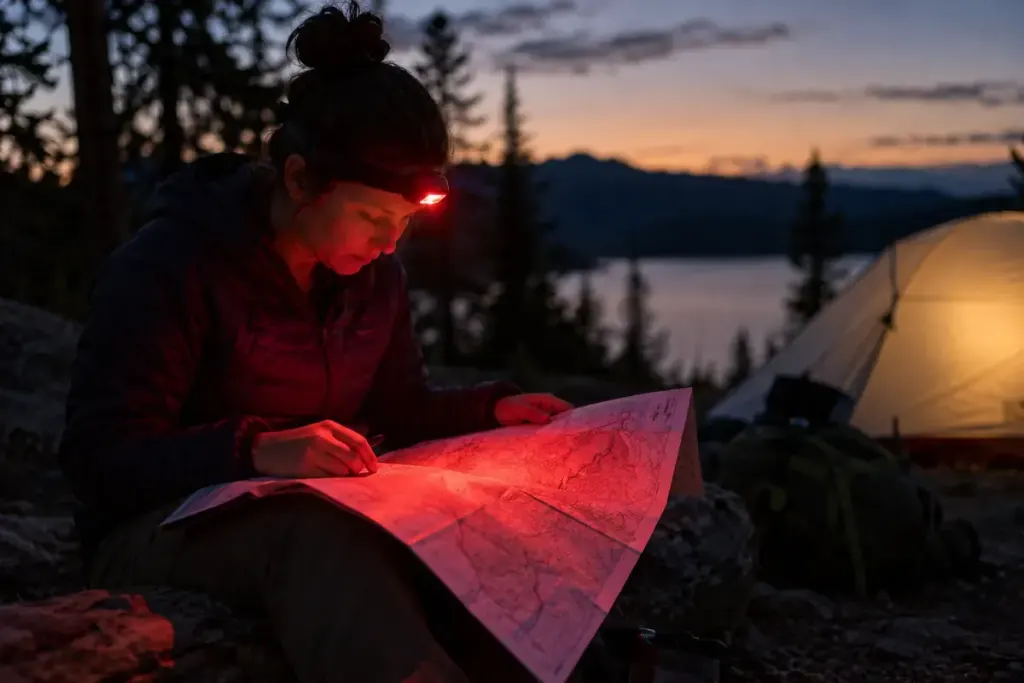
You switch a headlamp to red mode, then accidentally cycle through its brightest white setting while adjusting it. Around a dark campsite, the way you operate the lamp matters as much as the colour printed on the box.
The US National Park Service’s night-vision explanation describes why dim red lighting is useful for dark-adapted eyes and why bright light can disrupt that adaptation. It also notes that a bright red light can still interfere, so red does not mean unlimited brightness.
Learn the controls before darkness
Find out whether your lamp can start directly in red mode, whether it remembers the previous setting and how its lock works. Practise those actions in daylight. Some lamps require cycling through other modes; knowing that in advance helps you avoid shining an unexpected beam across someone else’s face.
Keep the light directed at the task and use only the brightness you need. A map on your lap requires a different beam from a route over uneven ground. Red light can also make some coloured map markings harder to distinguish, so check the actual information you must read.
Do not trade safe footing for dark adaptation
If you cannot see a step, obstacle or route clearly enough, use appropriate lighting and move cautiously. Preserving night vision is not a reason to walk blindly. Let companions know before using a brighter beam so they can look away.
At an organised astronomy event, follow the host’s lighting rules and ask where to stand or move. Phone screens can be another bright source even when the headlamp is well managed. Set up the device before the observation begins rather than discovering a glaring notification in the middle of it.
A practical packing check includes battery condition, a secure fit and a backup suited to the activity. Red mode is a useful feature, but it does not replace a reliable light or knowledge of the site.
Try a calm rehearsal near camp: locate the red control, read the information you need, switch off, and stow the lamp without triggering another mode. That small routine makes the feature useful to you and less disruptive to everyone sharing the darkness.