
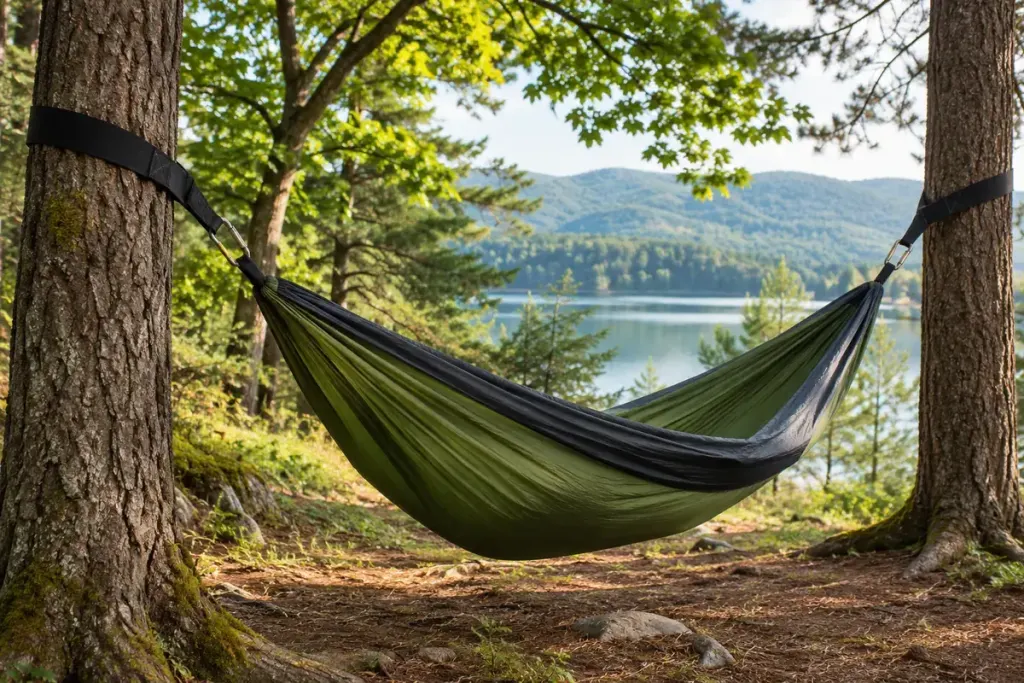
A narrow cord can hold a hammock while concentrating pressure on a small area of bark. That is why tree-friendly suspension is about how the load meets the tree, not merely whether the hammock stays off the ground.
Before choosing a pair of attractive trunks, establish whether hammocks are permitted at the site. Some places restrict them, specify protective equipment, or provide designated stands instead.
Read the local rule as a complete instruction
The Minneapolis Park and Recreation Board’s hammock guidelines provide one concrete example. They require wide straps, protective padding, suitable trees, and straps laid flat rather than twisted. They also exclude certain tree species and unsafe arrangements.
Those dimensions and restrictions belong to that park system; another site may have different requirements or prohibit tree attachment entirely. Copying only a strap-width figure while ignoring padding or tree restrictions misses the point.
Look at the ground and the canopy too
A suitable setup needs more than two trunks the right distance apart. Avoid damaged trees, suspect overhead branches, sensitive vegetation, and locations that obstruct paths. If you cannot confidently assess the supports, choose an approved stand or a different resting arrangement.
Follow the hammock and suspension manufacturer’s load and setup instructions. Do not stack hammocks or improvise attachments to railings, structures, or trees without permission. Wide webbing folded into a narrow strip no longer presents the same contact surface.
For a day outing, inspect the site before unpacking everything. Finding that the permitted area has no suitable supports is a reason to change the plan, not stretch the rules because the hammock is already out of its bag.
When leaving, remove the entire setup and check that no straps or litter remain. Repeated use can affect the same trees and ground even when each visit seems brief. A comfortable afternoon should not depend on turning a living tree into an unmaintained piece of equipment. Permission, correct protection, and a willingness to use another option are all part of the same outdoor skill.