
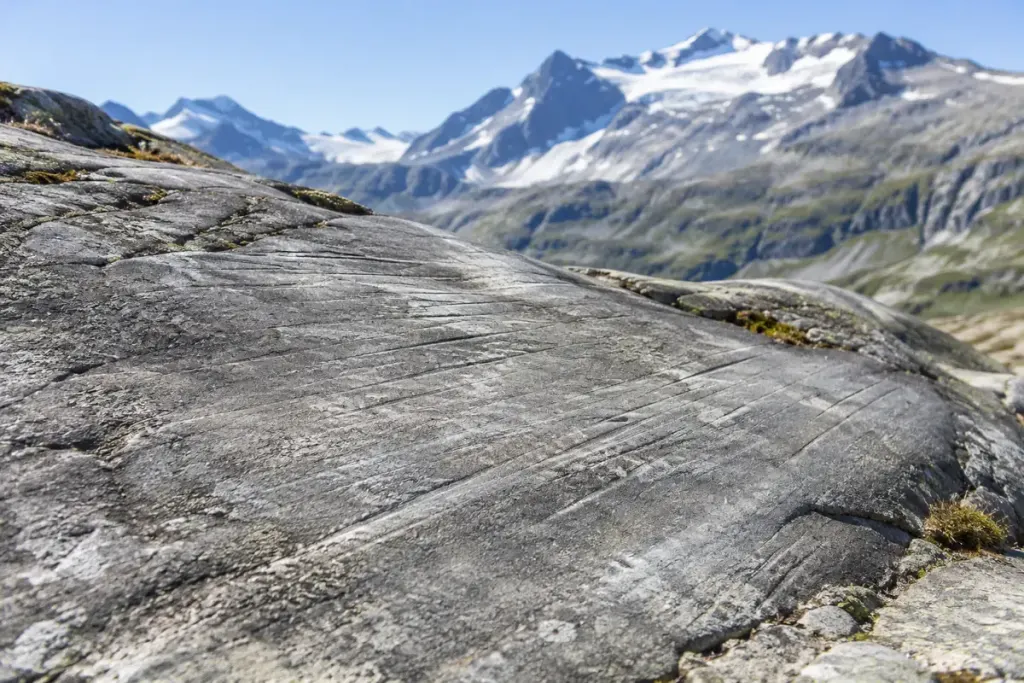
A smooth slab beside a mountain path carries several long, roughly parallel scratches. They may be evidence of ice that disappeared long before the present trail existed. Glacial striations form when rock fragments carried at the base of moving ice scrape the bedrock beneath.
The US National Park Service explains how this abrasive action can both scratch and polish a surface. The marks help researchers investigate past ice movement. They belong to the rock’s landscape history, not to the route markings provided for today’s walkers.
Look for a pattern, then check its context
One isolated groove is not enough to identify the process confidently. Notice whether several marks run together, whether the surrounding surface is smoothed, and whether the site’s interpretation identifies former glaciation. Natural fractures, weathering and human activity can also leave lines on rock.
Photograph a broad view before taking a close-up. The wider image records where the marked slab sits in the landscape; the close-up shows the grooves. Keep a scale beside the surface if this is safe and permitted, without scratching, chalking or wetting the rock to improve the picture.
A line is not automatically an arrow
The orientation of a groove gives a line along which movement occurred, but a casual photograph may not establish which way along that line the glacier travelled. More detailed interpretation can use additional features and regional evidence. Avoid adding a confident arrow to a caption simply because the valley slopes that way today.
For a walking notebook, record the location, viewing direction and the source of the geological identification. Separate an observed feature from an explanation supplied by a park sign or guide.
Stay on the permitted path and leave the surface intact. Polished rock may be slippery, particularly when wet. A careful observation from a safe position can make a familiar walk more interesting without turning a small geological discovery into a reason to scramble onto an exposed slab.