
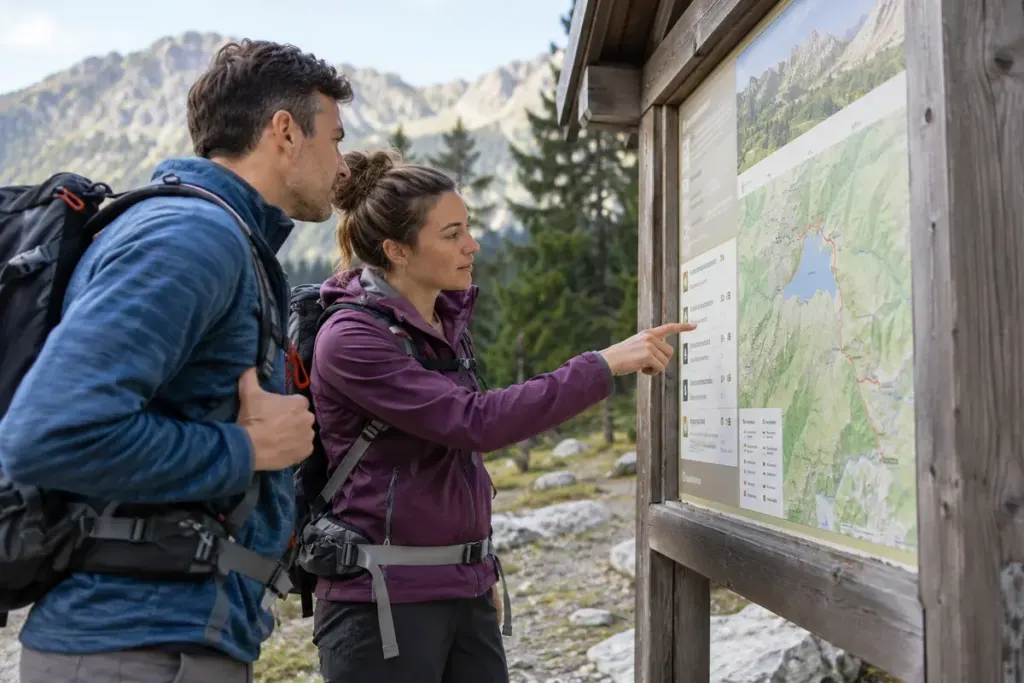
A sign says the waterfall is four kilometres away. That does not necessarily mean the outing is four kilometres long. If the route ends at the waterfall and you return the same way, the walking distance is eight kilometres before any detours.
Read the route description for words such as one way, return, round trip or loop. If the wording is unclear, ask the managing organisation or use its current route information rather than choosing the interpretation that fits your schedule.
Draw the journey you will actually make
Mark the start, destination and finish. For an out-and-back route, include both directions. For a loop, confirm that the published distance covers the complete circuit and check how far your parking place or transport stop lies from the trailhead.
A fictional plan might include a 6-kilometre loop plus 800 metres each way from a bus stop. The actual walking distance is 7.6 kilometres. A viewpoint spur of 500 metres each way would bring it to 8.6 kilometres.
Distance is only one part of effort. Elevation change, surface, weather, daylight and the group’s abilities affect the plan. Do not turn a distance calculation into a guaranteed finishing time.
Check the return before starting
For a point-to-point walk, confirm how you will leave the finishing location. A bus symbol on an old map is not proof of a service at the time you need it. Keep a practical alternative that does not depend on walking an unplanned long road section.
Check current access notices and carry suitable navigation and equipment. A route closure can change the distance or remove the assumed return path altogether. Follow local guidance and turn back when conditions or the group’s capacity require it.
Share a clear plan with someone appropriate: start, intended route, finish and expected contact time. “The four-kilometre waterfall walk” is less useful than a description that explains whether you are returning, continuing or meeting transport elsewhere.