
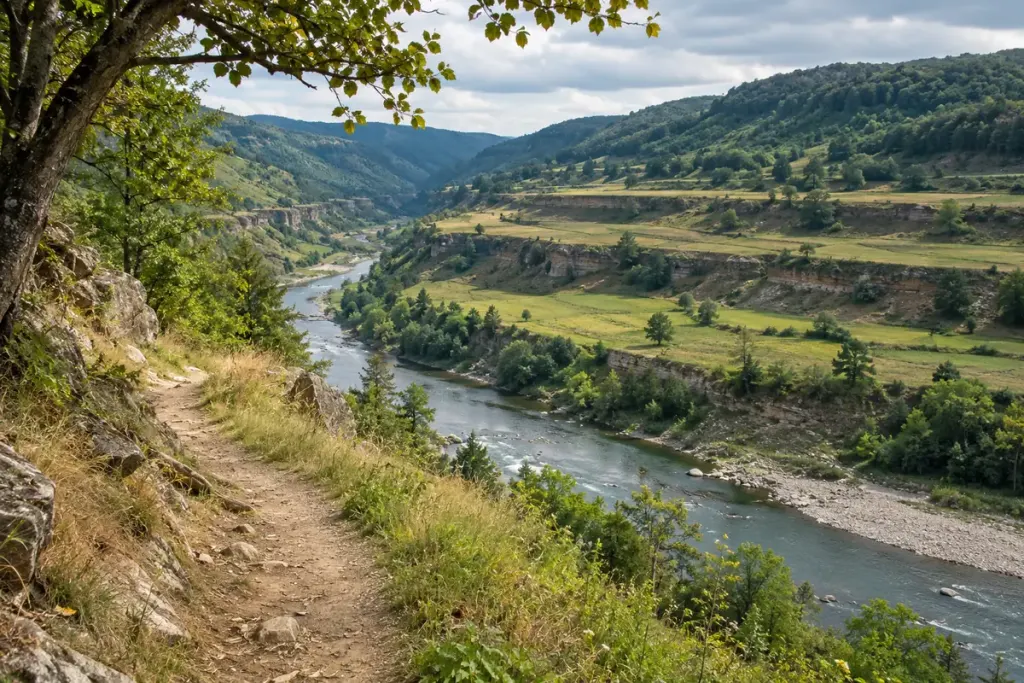
A path follows a broad, almost level bench above the water. Below it, a steeper slope drops to the present river. That step in the landscape may be a river terrace: a remnant of an older surface left above a channel that has cut down.
The US Geological Survey’s guide to measuring landscape change provides a useful framework for observing rivers and hillslopes. Terraces can preserve evidence of earlier river levels, but recognising a possible terrace is different from establishing its age or the precise events that formed it.
Look for a surface and a break in slope
From a safe public viewpoint, identify the relatively flat tread and the steeper riser beneath it. Look along the valley to see whether similar benches continue or reappear. Vegetation, buildings and later erosion can interrupt the pattern.
Not every flat patch beside water is a natural terrace. Roads, railway formations, landscaped ground and embankments can create convincing steps. A map, geological description or local interpretation panel may explain more than the shape alone.
Record what you see before explaining it
Try a three-part field note: location, visible form and question. For example: “From the bridge, a broad bench follows the outside of the bend; is this an older floodplain surface or made ground?” This keeps an observation separate from an attractive but untested story.
Terraces may involve river deposits or surfaces cut into underlying material. Their development can reflect several changes in a river system. You cannot confidently assign a particular flood, climate period or geological age simply because one bench stands higher than another.
There is no need to climb a crumbling bank or enter private ground to investigate. Use existing paths and distant views. A landscape sketch showing the present channel, the bench and the intervening slope often captures the essential relationship more clearly than a close photograph of loose stones. The next useful step is finding local geological evidence, not collecting a sample from an unstable face.