
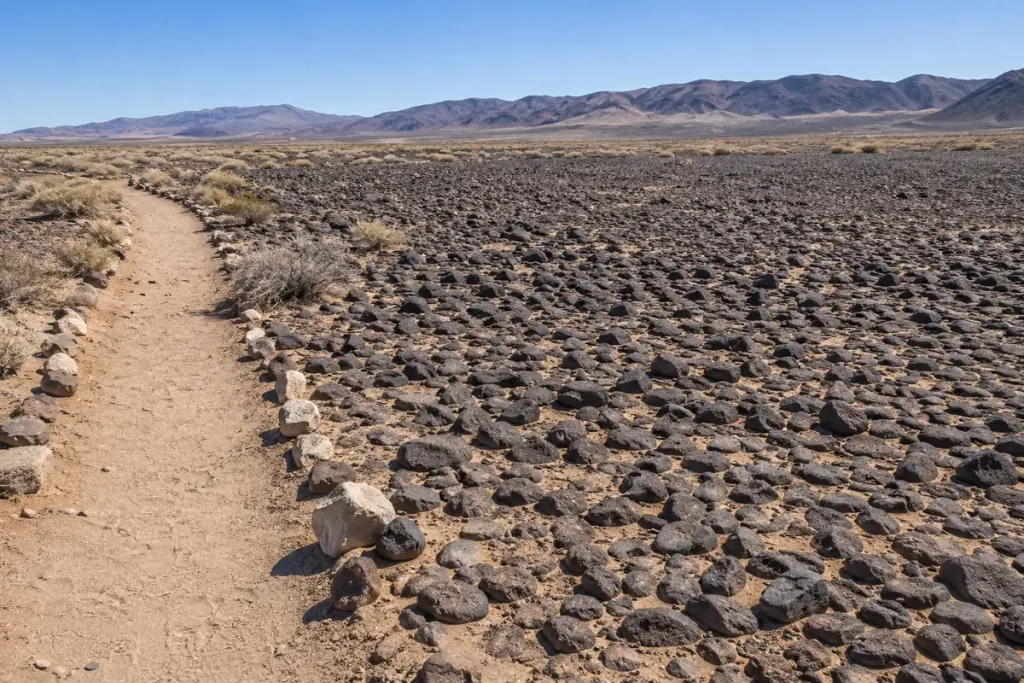
A desert surface covered in tightly packed small stones can look almost constructed. The name “desert pavement” captures that appearance, but it is a natural land surface rather than spare road material or an invitation to create a new walking route.
The US National Park Service describes desert pavement among arid-region landforms as a closely packed surface layer of coarse pebbles and gravel. Its geological glossary provides additional context about the concentration of coarser fragments. The appearance alone does not tell a visitor the full history or age of a particular patch.
Observe the pattern without rearranging it
From an authorised trail or viewpoint, look for the spacing of stones, changes in colour and boundaries with neighbouring surfaces. A photograph that includes a wider area can show more than a close-up of a single pebble. Do not lift stones or scrape the surface to improve the picture.
Natural stone cover and biological soil crust are not interchangeable labels. A landscape may contain several surface types close together, and a casual glance is not a reliable permission test for walking across them. Follow the land manager’s route and access instructions.
Make a route decision before the shortcut
Imagine reaching a bend where a flat stony patch appears to offer a shorter line. The useful question is not simply whether it looks firm enough for boots. Check whether the route is permitted and whether leaving it would disturb the site. Stay on the designated route when that is the requirement, even if an unmarked surface looks easy.
For a landscape notebook, record the location from the permitted route, the visible surface pattern and any interpretation supplied by the park. Keep your own guesses separate from the site’s explanation.
Seeing a desert as a collection of distinct surfaces makes a walk more interesting. It also replaces the misleading idea of “empty ground” with a better reason to slow down, observe and leave the surface as you found it.