
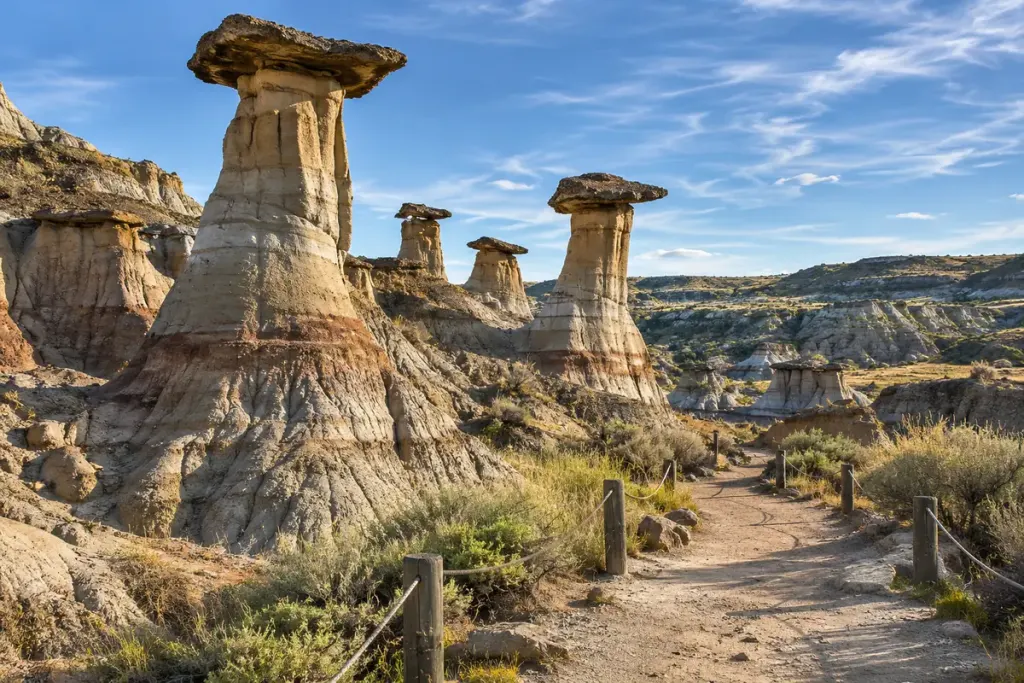
A hoodoo can resemble a stone figure, a tower or an improbable stack. The shape is not simply a rock that has been balanced on another rock. It is what remains as surrounding material breaks down and is removed at different rates.
At Bryce Canyon, the US Geological Survey’s landscape account describes weathering and erosion working through layered rock. Water entering cracks and freezing can help break the rock apart, contributing to a sequence from walls to openings and isolated forms.
Look for the layers before naming the shape
From an authorised viewpoint, trace a visible band across neighbouring pillars and slopes. Does a projecting cap sit above a narrower section? Are similar colours or textures repeated at the same level nearby? These observations help you see the landform as part of a wider sequence rather than as a standalone sculpture.
The National Park Service’s Life of Hoodoos interpretation explains frost wedging in the Bryce landscape. That mechanism belongs to the conditions and materials discussed there. A tower in another region may have a different geological history, so do not export every detail from one park to another.
Make a useful trail note
Record the viewpoint, date and the feature you can actually see. “A harder-looking cap projects above a narrow column” is an observation; identifying the rock type or dating its formation requires supporting geological information.
If you take a photograph, include some surrounding terrain in addition to a close crop. The wider view often shows the layers and neighbouring forms needed to understand the pillar. Keep interpretive signs or official geological references with your notes so you can revisit the explanation later.
Stay on permitted routes and keep away from unstable edges. A dramatic overhang is not an invitation to stand beneath it for scale, and climbing a fragile formation can damage both the feature and the visitor.
The most rewarding view may be the one that shows several stages at once: a wall, an opening and a freestanding pillar. Together they make the landscape’s changing structure easier to read.