
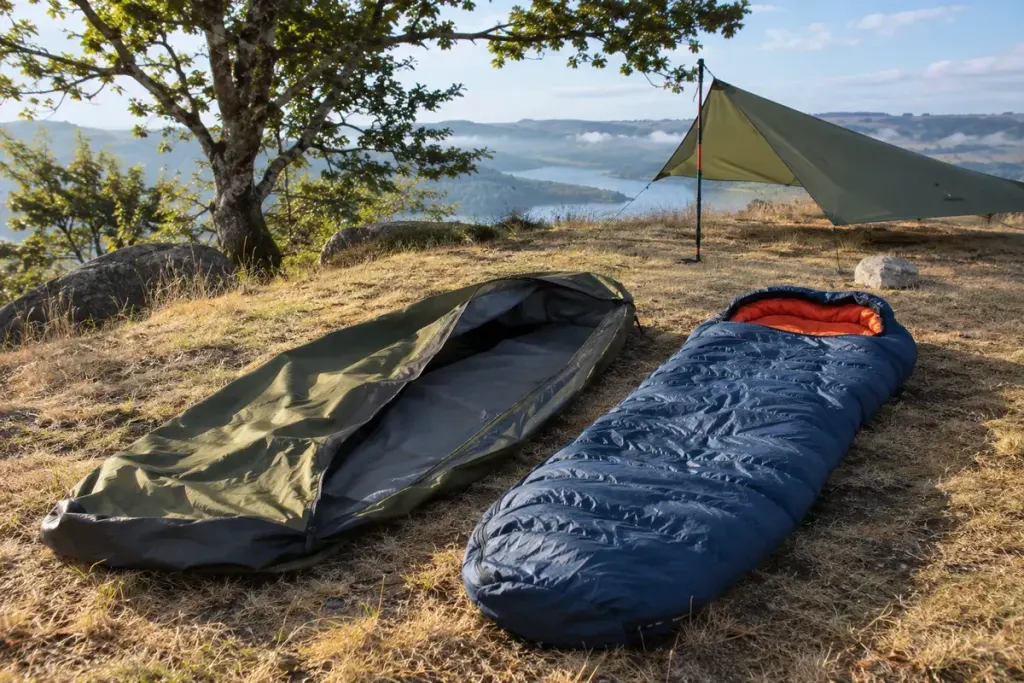
A bivvy bag can pack into a small bundle yet feel unexpectedly tight once a sleeping bag and its occupant are inside. Packed dimensions describe luggage space. They do not tell you whether the complete sleep system fits comfortably.
Check internal room with the equipment you intend to use, rather than choosing only by the length of the person on the product chart.
Compare the shape, not just the longest dimension
The Alpkit Hunka XL product information distinguishes an oversized design intended to accommodate longer sleeping bags and additional room. Its dimensions and features describe that model; another bag’s “XL” label may mean something different.
Look at shoulder and foot space, the opening and the intended position of the sleeping mat. Do not assume a mat belongs inside every bivvy design. Follow the manufacturer’s arrangement.
Try the whole system at home
Use the actual sleeping bag, clothing and mat configuration on a clean surface. Check whether the outer fabric pulls tightly across the sleeping bag, whether you can change position and whether you can enter and exit without difficulty.
Keep your face and breathing route unobstructed, and do not seal yourself inside. Practise the opening’s operation in a safe setting before considering an overnight trip.
An illustrative fit note might say: “Enough foot length, but shoulders feel constrained when turning.” That is more useful than simply recording that your height is below the product’s maximum stated length.
Room does not replace suitable equipment
A larger cover does not make a sleeping bag warm enough for every forecast or remove the need for suitable ground insulation. Assess the whole system for the planned conditions and choose a lower-commitment trial in mild weather if you are new to it.
Check the maker’s care instructions and local rules for overnight use at the intended site. A first experiment should include an easy way to stop if the arrangement is uncomfortable or unsuitable.
When comparing options, keep packed size and occupied fit as separate columns. The most compact item in a backpack is not automatically the most workable shelter when everything inside it needs room to function.