
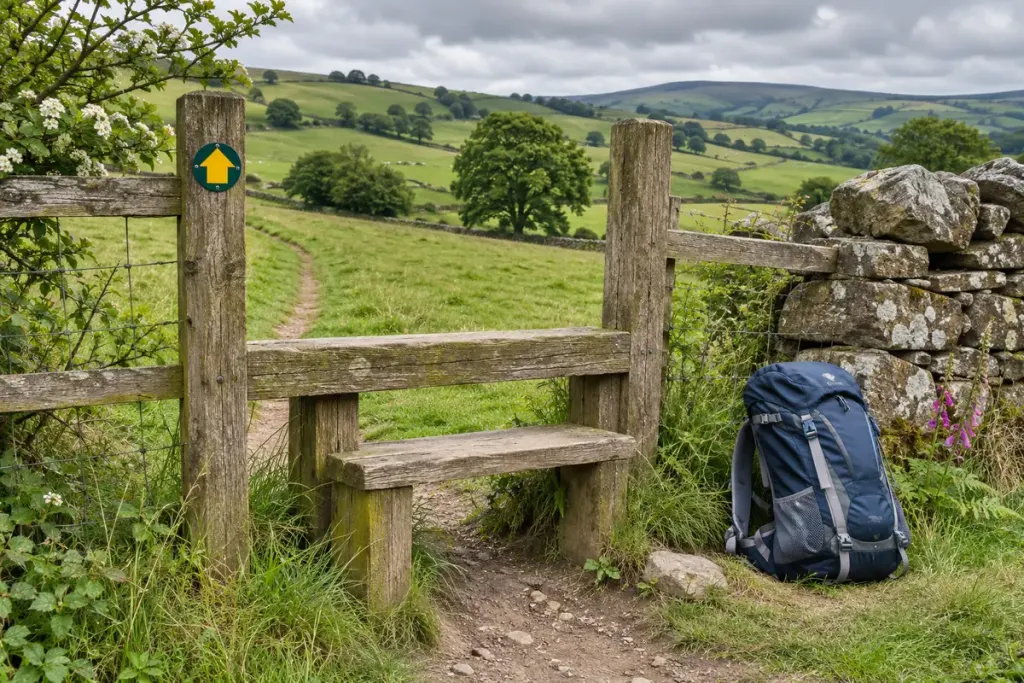
A stile that looks straightforward on a route photograph can feel different with a full rucksack, wet boots and a queue of walkers behind you. Treat it as a short change in how you move, rather than another place to keep walking at the same pace.
The Countryside Code for England and Wales asks visitors to use gates, stiles or gaps where available instead of damaging boundaries. Access rules elsewhere differ, so follow the signs and guidance for the place you are visiting.
Pause before putting weight on the step
Look at the condition of the crossing and the ground on the far side. Mud, a loose board or an awkward drop can change the decision. Do not climb a damaged structure simply because a map shows the path continuing beyond it.
Secure loose straps and organise poles so they will not catch or occupy a hand you need for support. If a bulky pack makes the movement unstable, assess whether it can safely be removed and passed across with help. Avoid balancing a heavy bag on the top rail where it could fall onto someone.
Cross one at a time and leave space for the person ahead to step clear. A pause is preferable to another walker pressing close while someone is turning or finding a foothold.
Plan around the group’s actual needs
A route described as short or easy can still contain barriers that make it unsuitable for a particular walker. Before setting out, look for current access information, including gates, stiles and alternative routes. Distance alone does not describe accessibility.
If the crossing cannot be used safely, choose a lawful alternative or turn back rather than climbing a nearby fence. Report a damaged public-path structure through the relevant local channel when possible, giving a precise location.
The useful habit is to stop treating the pack and the crossing as separate problems. A safe route is one the walker can use with the equipment they are actually carrying that day.