
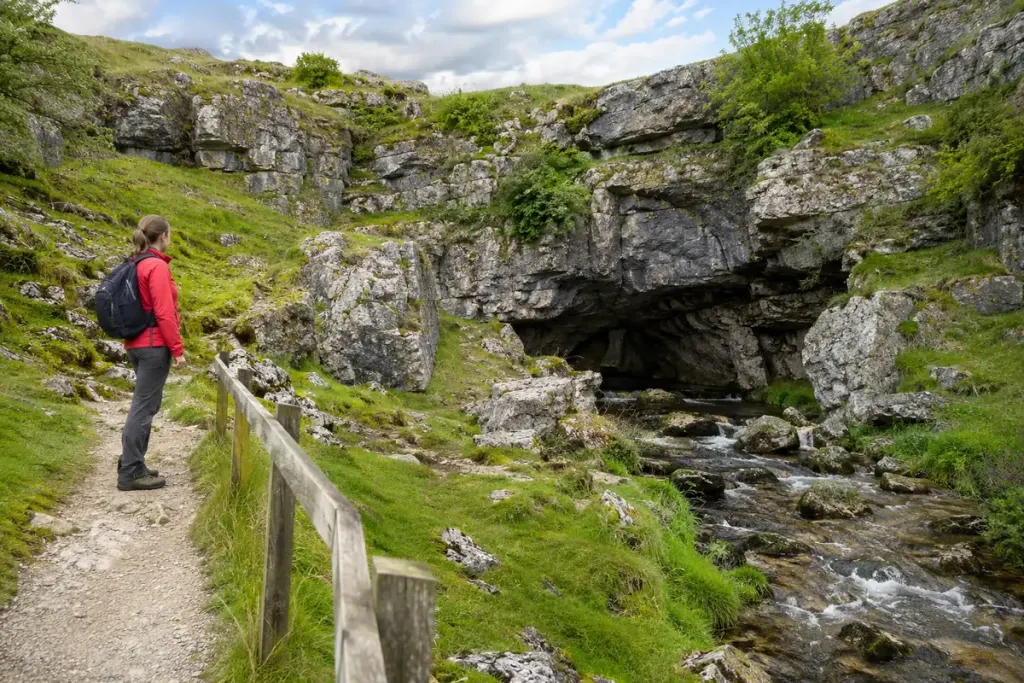
A stream follows the path for a while, then dwindles into a stony bed. Farther on, water emerges from a spring. In a karst landscape, surface water and underground routes can be closely connected, but the route between two visible points is not something a walker can confidently draw by eye.
The Missouri Department of Natural Resources explains losing streams in areas where dissolved bedrock creates openings and underground pathways. Water can enter the subsurface more quickly than it would by slowly filtering through soil.
Notice the change without following it underground
From the established route, observe whether flow reduces gradually or disappears at a more concentrated point. Note the date and recent conditions if you know them. A dry channel on one visit does not establish that it is always dry.
British Columbia’s karst management handbook describes sinking and losing streams and the way some channels behave during changing runoff conditions. That variability is part of the landscape, not necessarily an error on the map.
Do not leave a marked path to inspect an unstable opening, enter a cave without the appropriate expertise and arrangements, or assume a dry passage will remain dry. The observation is useful without turning it into an exploration of a concealed drainage route.
Keep a spring separate from a drinking-water source
Clear-looking water is not proof of safety. Rapid movement through underground pathways can carry contamination, and the source area may extend beyond what is visible nearby. Use the water treatment and supply plan appropriate to the trip; do not drink simply because the water has emerged from rock.
A good walking note might record “flow disappears beside the marked trail at this location” with a map reference and photograph. Avoid asserting that a distant spring is the same stream unless a reliable geological source documents the connection.
The interesting feature is the exchange between the visible landscape and the hidden water system. Careful observation lets you appreciate that connection while preserving the uncertainty that the surface view cannot resolve.