
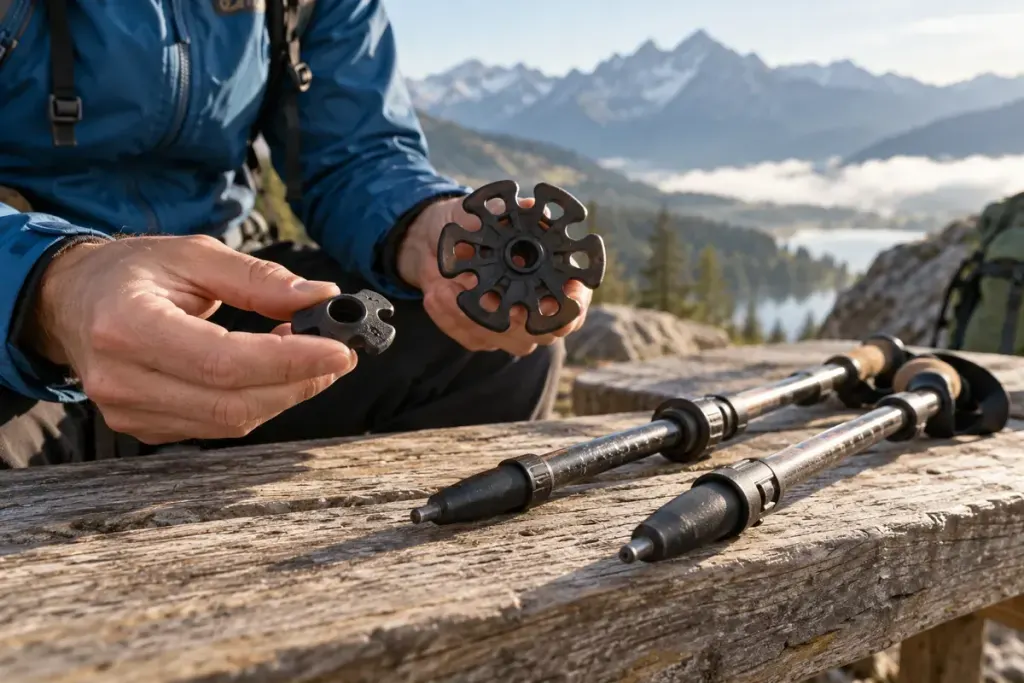
The small disc near a trekking pole’s tip can be easy to overlook until the pole sinks farther into soft ground than expected. That disc is a basket, and different designs suit different conditions.
A larger snow basket offers more surface area than a small hiking basket. REI’s own-brand snow-basket description, for example, explains its purpose in limiting sinking into snow and specifies compatible poles. That compatibility statement matters as much as the shape.
Match the attachment to the actual pole
Look up the pole model and the manufacturer’s approved basket options. Some attachments screw into place; others use a different fixing system. A basket that looks close in size is not necessarily secure on another brand or generation of pole.
Check both poles before packing. Note any missing parts, cracks or loose fittings, and follow the maker’s instructions for replacement. Do not force an incompatible piece or improvise a fixing that could detach during use.
Lay the removed and replacement parts beside the instructions while working. This makes it easier to confirm that both poles have the intended attachment and that no small component has been left on the bench.
Think beyond the basket
Basket choice is one equipment decision within a much larger route decision. A larger disc does not make unstable snow, a difficult crossing or steep winter terrain safe. Conditions, experience, footwear and the rest of the equipment still need an appropriate assessment.
For a routine check in a safe, low-consequence area, observe how the pole tip and basket meet the surface. If the attachment moves or the pole behaves unexpectedly, stop and inspect it rather than increasing pressure to see what happens.
Keep the spare baskets labelled with the compatible pole model at home. When borrowing or lending poles, tell the next person which attachments are fitted and provide the relevant instructions.
The useful habit is to inspect the small parts while preparing the whole walking kit. It is easier to resolve an uncertain fitting at a table than to discover that the two poles have different baskets after the route has begun.